
Turn the Ship Around
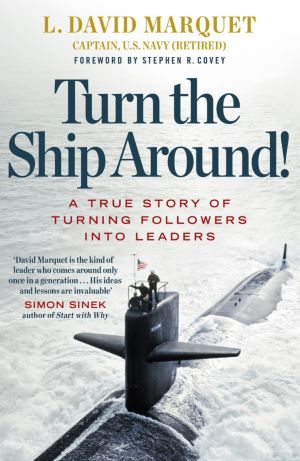
I learned about the Turn the Ship Around book by David Marquet at a full-day workshop intended to address empowerment issues in the organisation I worked for. It was briefly mentioned on a slide as additional literature.
I mostly read the book as an audiobook, so it was a nice bonus that the author narrated it himself. The great reviews were also a convincing factor. Not to mention the naval theme that I’m generally fascinated by. My excitement was at an all-time high when I started the book. I was really looking for something eye-opening or truly new that would grow my leadership knowledge. Maybe I overcharged myself, but my desires were left unsatisfied. It’s not that the book is bad; it is a solid one, but nothing extraordinary.
The book consists of 29 chapters organised into 4 parts. They go through a kind of expected curve, setting the stage for how the Navy does things, how the author tried an unusual leadership style in his first steps, how he failed initially, what he changed, and finally, how he ultimately succeeded. There is nothing wrong with that.
What I had a problem with was the somewhat obvious points about how the book was progressing. It’s true that in the Navy, a very authoritative leadership is exercised, which is probably pushed to the extreme on a nuclear submarine. From this point, what David Marquet has achieved with the USS Santa Fe is truly remarkable. On the other hand, in software engineering, for example, we don’t have that rigid commanding line, if we have it at all. I was also unlucky several times during my career, and some of my project managers felt they needed to be dictators ruling the development team, but they are rather the exception than the norm, as in the Navy.
One of the best examples was at a very prominent place in the book, almost in the end, in the finale, after the book tried to prove its value through chapters and decorating stories. One would expect some crazy story that ultimately makes the point. But that story was the following. The Santa Fe was about to pick up some SEALs in the ocean during the night, and the crew autonomously prepared for them! Blankets were stacked in case they were needed, soup was prepared at three o’clock in the morning, the nuclear reactor was running to provide electric power and steam, the doctor was also prepared to treat any injured SEALs, and so on. Well, if this preparation is really not expected to be carried out autonomously in the Navy by default, then I’m truly amazed at what David Marquet achieved on the USS Santa Fe. Otherwise, ehh, nothing special.
What I liked the most:
- Not much, it is just okay
What I didn’t like much:
- Nothing special, somewhat obvious points and decorating stories
Comments